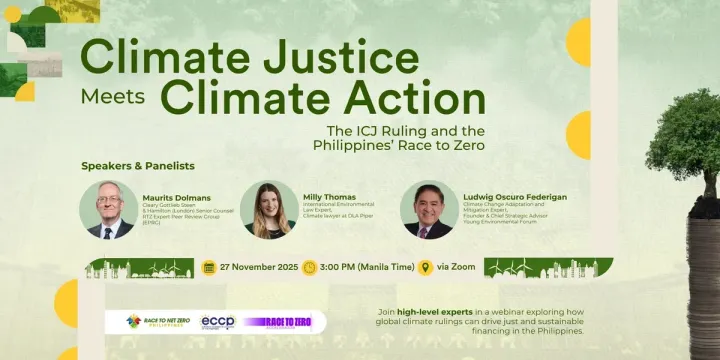
Climate Justice Meets Climate Action: The ICJ Ruling and the Philippines' Race to Zero
- Date November 27, 2025
- Time 3:00 PM - 5:30 PM
- Venue Zoom / Webinar
The Philippines is among the world’s most climate-vulnerable countries, confronting escalating risks to livelihoods, ecosystems, and infrastructure. The ICJ advisory opinion and COP30 outcomes provided the backdrop for this webinar, with discussions on climate accountability, loss and damage funding, transparency frameworks, just transitions, and sustainable finance.
Achieving the 1.5°C goal remains a moral and developmental imperative. For the Philippines, this requires sustained investment in renewable energy, green jobs, and resilience-building. The webinar provided a timely, structured dialogue on how global climate rulings and negotiations could translate into national financing and governance strategies.
The session featured Maurits Dolmans, Senior Counsel at Cleary Gottlieb Steen & Hamilton (London) and Member of the Race to Zero Expert Peer Review Group (EPRG), who explored how climate change is reshaping business, finance, and investment in vulnerable countries like the Philippines, and the opportunities and obligations this creates.
Joining him was Milly Thomas, International Environmental Law Expert and Climate Lawyer at DLA Piper, who examined the ICJ Advisory Opinion and global climate obligations, highlighting the role of states and the private sector in driving resilience, justice, and sustainable action.
To localize the perspective, Ludwig Oscuro Federigan, Subject Matter Expert at the Co-operative College of the Philippines, shared how COP30 outcomes could drive the Philippines’ climate action, aligning national policy with global finance, loss and damage mechanisms, and a just, resilient transition.
The session aimed to strengthen participants’ understanding of how global climate decisions could inform effective, accountable, and locally relevant climate action, supporting a more resilient and sustainable future for the country.